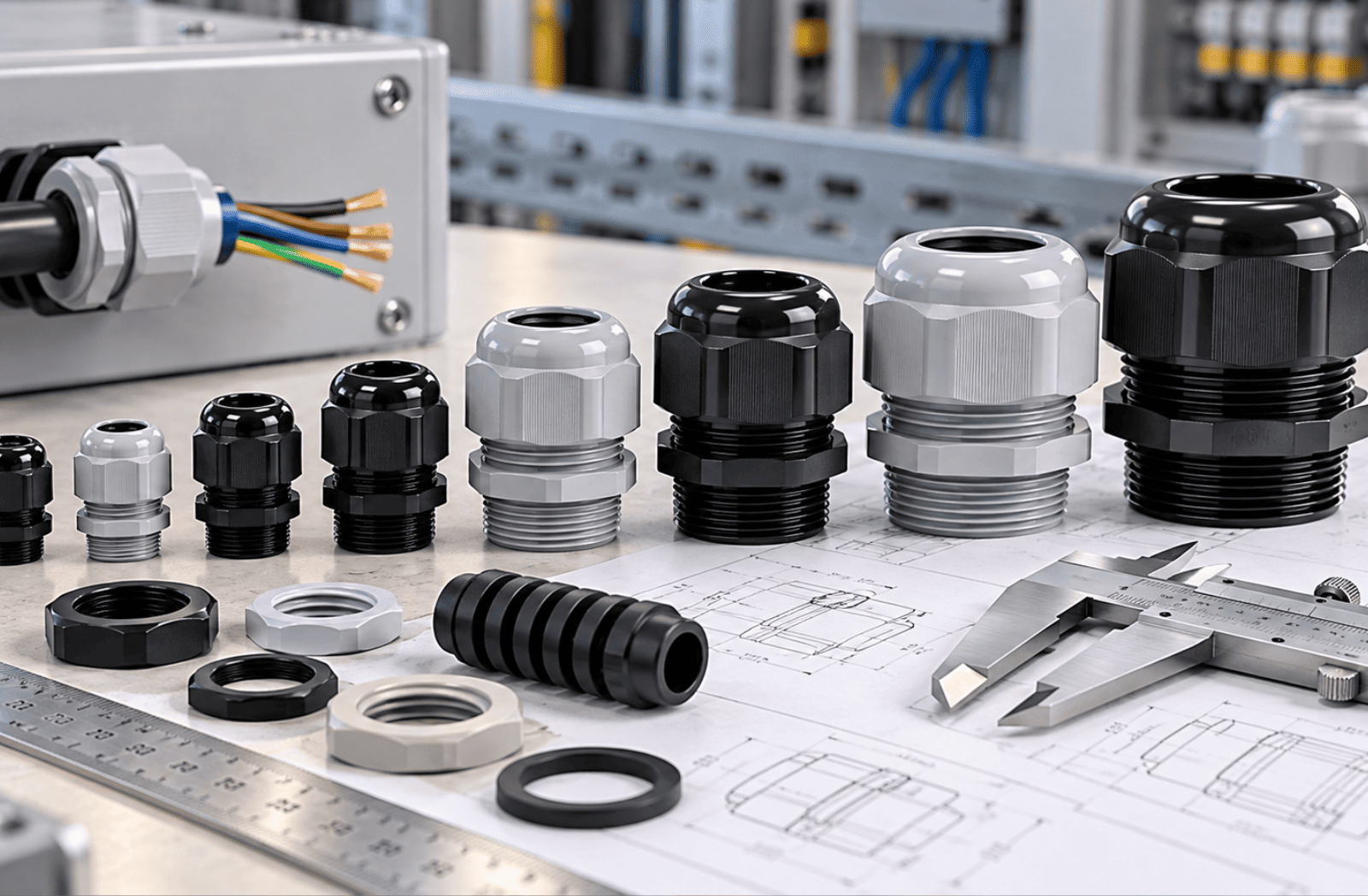
When choosing a cable gland, one of the most confusing markings you may come across is PG.
You may see terms such as PG7, PG9, PG11, PG13.5 or PG16 on electrical equipment, enclosures and cable glands. But what do those numbers actually mean? Does PG11 mean an 11 mm gland? Can a PG gland be replaced with an M-size gland? And how do you select the right PG gland for your cable?
Getting these details wrong can lead to poor cable sealing, an incorrect enclosure entry or a gland that simply does not fit.
This guide explains PG cable glands, how PG sizes work, how to select the correct size, and what to check when sourcing PG glands for electrical projects in the UAE.
What Is a PG Gland?
A PG gland is a type of cable gland with a PG (Panzergewinde) thread, a German-origin thread system historically used for electrical conduit and cable-entry applications. PG cable glands are still encountered particularly in existing machinery, control cabinets, electrical equipment and installations designed around the PG system.
A cable gland generally performs several functions at the point where a cable enters an enclosure. Depending on its design, it can provide:
Cable entry → mechanical retention → sealing → strain relief → enclosure protection
The important point is that the gland needs to match both the cable and the enclosure entry.
A gland that fits the cable but has the wrong thread is not the correct gland.
What Does PG Mean?
PG comes from Panzergewinde, a German term associated with the armoured/steel conduit thread system. The PG thread system was codified in DIN 40430 and is now considered a legacy thread system, but PG cable glands remain in use for compatible equipment and replacement applications.
This is why you may still find electrical equipment using markings such as:
PG7 | PG9 | PG11 | PG13.5 | PG16 | PG21 | PG29
One important detail:
The number after PG should not simply be treated as the cable diameter in millimetres.
For example, a PG11 gland is not simply an “11 mm gland.” The PG designation identifies a particular thread size and corresponding cable-clamping range.
PG Gland Sizes: The Quick Reference
One of the easiest ways to understand PG glands is to look at the common sizes alongside their cable ranges.
|
PG Size |
Approx. Major Thread Diameter |
Typical Cable Clamping Range* |
|---|---|---|
|
PG7 |
12.5 mm |
3–6 mm |
|
PG9 |
15.2 mm |
4–8 mm |
|
PG11 |
18.6 mm |
5–10 mm |
|
PG13.5 |
20.4 mm |
6–12 mm |
|
PG16 |
22.5 mm |
8–14 mm |
|
PG21 |
28.3 mm |
10–18 mm |
|
PG29 |
37.0 mm |
16–25 mm |
|
PG36 |
47.0 mm |
22–32 mm |
|
PG42 |
54.0 mm |
28–38 mm |
|
PG48 |
59.3 mm |
36–44 mm |
*Cable ranges vary by manufacturer and product construction, so the manufacturer’s technical data should always be checked before specifying a gland. The ranges above are representative figures published by WISKA and other technical references.
The important takeaway
PG number ≠ cable diameter.
Instead, think of it as a size designation that relates to a specific thread and compatible cable range.
That’s one of the most common points of confusion when selecting a PG cable gland.
How to Choose the Right PG Gland in 3 Steps
You don’t need to make PG gland selection complicated.
Start with these three checks.
Step 1: Measure the Cable Outside Diameter
Measure the actual outside diameter of the cable, not just the conductor size printed on the cable.
For example, if your cable has an outside diameter of approximately 8 mm, a PG gland with a suitable clamping range needs to be selected.
Do not assume that a larger PG number is automatically better.
The goal is to find a gland whose specified cable range properly accommodates the cable.
Step 2: Check the Enclosure Thread
This is where many otherwise suitable selections go wrong.
The gland must match the thread in the enclosure, panel or equipment.
For example:
Existing entry = PG11
You should select a compatible PG11 gland, unless the installation has been specifically designed to use an adapter or another thread arrangement.
A metric gland that has a similar cable-clamping range does not automatically make it a compatible replacement, because PG and metric threads use different thread geometries.
Step 3: Check the Required Protection
Finally, check the environmental and enclosure-protection requirements.
Depending on the product, cable glands may provide protection against the ingress of dust and moisture when correctly installed with compatible components.
For example, WISKA’s PG11 cable gland SKV 11 SG is specified with an IP68 rating under its stated test conditions, a 5–10 mm cable range and a PG thread.
The required IP rating should always be based on the application’s specification rather than choosing a rating simply because it is higher.
PG7 vs PG9 vs PG11: What’s the Difference?
These three sizes are often encountered in smaller cable-entry applications, but they accommodate different cable ranges.
PG7
Typically used for smaller cable diameters, with representative cable ranges around 3–6 mm depending on manufacturer.
PG9
A slightly larger option, commonly accommodating cables around 4–8 mm.
PG11
Larger again, commonly used for cables around 5–10 mm.
So if your cable is 7 mm in diameter, you should not choose a gland simply because PG7 looks close to “7 mm.” Instead, check the gland’s specified clamping range and the enclosure’s actual thread.
PG Gland vs M Gland: Can You Substitute One for the Other?
This is one of the most important questions when working with PG glands.
PG and M are different thread systems.
Metric cable glands use metric entry threads, while PG cable glands use the PG thread system. IEC 62444 covers general requirements and tests for cable glands and specifically covers glands with metric entry threads; it notes that the standard can also be used as a guide for glands with other types of entry threads.
Because the thread systems are different, a PG gland and a metric gland should not be treated as direct interchangeable replacements simply because their cable-clamping ranges look similar.
For existing equipment, the safest starting point is to identify the actual thread specification of the enclosure entry.
Why PG Glands Are Still Relevant
With metric cable-entry systems widely used in modern equipment, why are people still searching for PG glands?
The answer is largely existing equipment and replacement requirements.
PG cable glands are still used for compatible older machinery, control cabinets, electrical equipment and installations that already have PG entries. WISKA describes PG cable glands as classic cable-entry solutions particularly encountered in older machinery, control cabinets and existing installations.
For maintenance and replacement work, changing the entire enclosure entry just to move to another thread system may not always be practical.
This makes PG glands relevant to:
Maintenance teams
Panel builders
Electrical contractors
Industrial equipment suppliers
Machine manufacturers
Facility-management teams
What Happens When You Choose the Wrong PG Gland?
The wrong gland is more than a minor sizing mistake.
The cable may not be securely gripped
If the cable diameter is outside the gland’s specified range, proper clamping may not be achieved.
The seal may not perform as intended
Incorrect sizing can affect the sealing interface between the cable and gland.
The gland may not fit the enclosure
A PG gland cannot simply be forced into a metric entry, or vice versa.
The installation may not achieve its specified protection
The final level of enclosure protection depends on the complete installation, including the gland, cable, enclosure entry and installation method.
Installation time can increase
The wrong gland often means rework, replacement and unnecessary downtime.
PG Gland Material: What Should You Consider?
PG glands are available in different materials and constructions.
Depending on the product, you may encounter polyamide/plastic and metal cable glands, among others. WISKA, for example, lists PG cable glands made from polyamide with sealing components and specified protection ratings.
The choice should consider:
- Installation environment
- Mechanical requirements
- Temperature
- Moisture and dust exposure
- Corrosion conditions
- Cable construction
- Required protection level
- Project specifications
There is no single material that is automatically right for every application.
A Simple PG Gland Selection Checklist
Before ordering a PG cable gland, confirm these five details:
- Cable outside diameter
Measure the actual cable. - Existing enclosure thread
Confirm whether it is PG and identify the exact PG size. - Required clamping range
Make sure the cable falls comfortably within the manufacturer’s specified range. - Required protection
Check the application’s IP/environmental requirement. - Product specifications
Confirm material, operating conditions, certifications and installation requirements.
This simple process can prevent many common selection errors.
Where Are PG Glands Used?
PG glands may be encountered wherever compatible PG cable-entry systems are installed.
Typical applications include:
Control Panels
PG cable glands can be used for cable entry into existing control cabinets and electrical panels.
Industrial Machinery
Machines with legacy PG cable entries may require PG glands for maintenance or replacement.
Electrical Enclosures
PG glands can provide a cable-entry solution for compatible enclosure designs.
Automation Equipment
Control and instrumentation wiring may require appropriately sized cable glands at equipment entry points.
Maintenance and Retrofit Projects
PG glands are particularly relevant when an existing installation needs replacement components without changing its established cable-entry system.
PG Glands from Misterlight
Misterlight offers PG gland products as part of its Cable Gland Accessories range, including RUPAM PG Gland, GIANTLOK PG Gland and WISKA PG Gland.
The WISKA PG Gland listed by Misterlight is a cable gland with locknut and is identified on the product page as a polyamide gland.
For UAE projects, having access to compatible cable glands and related accessories can make sourcing easier, particularly when maintaining existing equipment or matching established installation specifications.
Looking for PG glands or other cable gland accessories in the UAE? Explore Misterlight’s cable accessory range or contact the team to discuss your requirements.
Frequently Asked Questions
What is a PG gland?
A PG gland is a cable gland that uses the PG (Panzergewinde) thread system for cable entry into compatible electrical equipment and enclosures.
What do PG7, PG9 and PG11 mean?
They are different PG thread-size designations, each associated with a specific thread dimension and cable-clamping range. They should not be interpreted simply as cable diameters in millimetres.
How do I know which PG gland size I need?
Measure the cable’s outside diameter and identify the thread size of the enclosure entry. Then choose a gland whose cable-clamping range matches the cable and whose thread matches the enclosure.
Can I use an M20 gland instead of a PG13.5 gland?
Not as a direct substitution simply because the cable range may be similar. PG and metric threads are different systems, so thread compatibility must be verified.
What is the difference between PG and M cable glands?
PG glands use the PG thread system, while M glands use metric threads. The thread must match the enclosure entry for a correct installation.
Are PG glands still used?
Yes. They continue to be relevant for compatible existing equipment, machinery, control cabinets and retrofit or maintenance applications.
Where can I buy PG glands in the UAE?
PG glands are available from electrical cable and accessory suppliers. Misterlight lists RUPAM, GIANTLOK and WISKA PG glands within its cable-gland-accessory range.
Conclusion
Choosing a PG gland becomes much easier once you stop thinking of PG numbers as simple measurements.
The correct selection comes down to three things:
Match the cable diameter.
Match the enclosure thread.
Match the required protection and product specification.
PG glands remain relevant wherever existing equipment and enclosures use the PG thread system, particularly in maintenance, replacement and retrofit applications.
For electrical projects and industrial installations in the UAE, Misterlight provides PG glands and a wider range of cable accessories to support different cable-entry requirements.
Need help selecting the right PG gland? Contact Misterlight with your cable diameter and enclosure thread specification.