Before You Buy Electrical Cables: 10 Questions Every UAE Project Should Ask
Choosing an electrical cable is rarely as simple as selecting a size and placing an order.
The right cable depends on much more than its conductor cross-section. Voltage, current, installation method, temperature, environmental exposure, fire performance, cable construction, applicable standards and even the accessories used for termination can all affect whether a cable is suitable for a project.
This becomes particularly important for projects in the UAE, where electrical installations may need to operate in demanding environments and comply with project specifications and applicable authority requirements.
Dubai’s DEWA electrical-installation regulations, for example, require cables to be adequately sized for continuous current under the applicable laying conditions and maximum ambient temperature, and specify that voltage drop should generally not exceed 4% from the supply point to the connected equipment unless otherwise specified. DEWA
So before you buy electrical cables for your next project, ask these 10 questions.
1. What Exactly Is the Cable Being Used For?
Start with the application.
A cable designed for general power distribution may not be the right choice for a fire alarm, instrumentation loop, industrial control system or high-temperature connection.
For example, a project may require different cable types for:
- Power distribution
- Fire alarm systems
- Emergency lighting
- Control systems
- Instrumentation
- Data transmission
- Fibre optic networks
- Machinery
- EV charging
- High-temperature applications
The first question should therefore be:
What job does this cable need to perform?
Misterlight’s portfolio reflects this application-based approach, with dedicated categories for fire-performance, instrumentation, fibre optic, control and data, flexible, high-temperature, EV charging and other specialist cables
2. What Cable Size Do You Actually Need?
One of the most common mistakes is assuming that cable selection begins and ends with conductor size.
Cable sizing should consider the expected load as well as how and where the cable will be installed.
Factors can include:
- Current carrying capacity
- Voltage drop
- Ambient temperature
- Grouping of cables
- Installation method
- Length of the cable run
- Thermal conditions
DEWA’s regulations specifically state that cables should be adequately sized to continuously carry the normal circuit current under applicable laying conditions and maximum ambient temperature. DEWA
For longer cable runs, voltage drop can also become an important consideration.
The takeaway
Don’t ask only:
“Is this a 4 mm² or 6 mm² cable?”
Ask:
“Is this cable correctly sized for the load, installation conditions and length of this particular circuit?”
3. What Voltage Rating Does the Project Require?
The cable’s voltage rating needs to match the electrical system in which it will operate.
Depending on the project, you may encounter:
- Low-voltage systems
- Control circuits
- Instrumentation systems
- Communication systems
- Higher-voltage power distribution
Using a cable simply because it physically fits an installation does not mean it is electrically suitable.
The cable’s:
Rated voltage → insulation system → construction → application
should all be checked against the project specification.
For fixed wiring installations in Dubai, DEWA regulations identify several applicable British cable standards depending on the installation and cable type.
4. Where Will the Cable Be Installed?
A cable installed inside a temperature-controlled electrical room may have very different requirements from one installed outdoors or in an industrial environment.
Before purchasing, consider whether the cable will be:
Indoor
Outdoor
Underground
In a cable tray
In conduit
Directly exposed
Near machinery
In a hazardous area
In a high-temperature environment
This matters because the cable construction needs to be compatible with its surroundings.
For example, DEWA specifically addresses wiring exposed to high temperatures and states that wiring should be suitably rated for the temperatures likely to be encountered.
For UAE projects, think beyond the room temperature
The actual installation environment may include:
Heat + sunlight + dust + humidity + mechanical exposure + industrial conditions
The correct cable should be selected accordingly.
5. Does the Cable Need Fire Performance?
Not every electrical circuit needs the same fire-performance characteristics.
But where cables form part of life-safety or critical systems, fire behaviour can become an important specification.
Applications can include:
- Fire detection
- Fire alarm systems
- Emergency lighting
- Voice alarm
- Emergency communication
- Fire-fighting control systems
- Other critical circuits
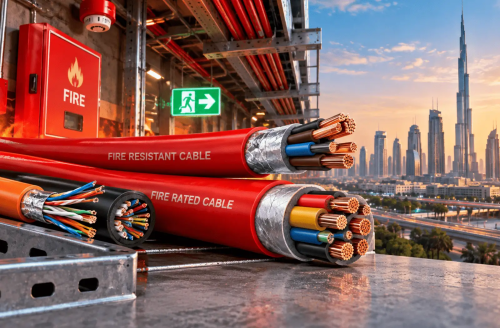
Misterlight’s fire-performance portfolio includes cables referencing standards such as BS 7629-1, BS 5839, BS EN 50200, BS 7846, BS 6387 and BS 8434-2, with BASEC approval and LPCB certification stated for relevant products.
The important point is:
Don’t simply ask for a “fire-rated cable.” Ask what fire performance the project actually requires.
A specification should identify the relevant standard, classification and application.
6. Is LSZH Required?
Another term buyers frequently encounter is LSZH — Low Smoke Zero Halogen.
LSZH construction can be relevant where reduced smoke and corrosive gas emission are important considerations during fire.
But LSZH and fire resistance are not the same thing.
A cable being LSZH does not automatically mean it provides a particular fire-survival classification.
Likewise, a fire-resistant cable may have additional construction requirements depending on the application.
Misterlight offers both fire-performance cables and EPR/LSZH flexible cable categories, illustrating why the two characteristics should be considered independently according to the project requirement.
7. What Cable Construction Is Right for the Installation?
There isn’t one cable construction that is ideal for every application.
Depending on the project, you may need to consider:
Armoured vs unarmoured
Armoured cables may be selected where additional mechanical protection is required and where the project specification calls for it.
Flexible vs fixed
Flexible cables are useful where the cable needs to accommodate movement or equipment connections.
Copper vs aluminium
Conductor material affects electrical and mechanical characteristics, installation and cost considerations.
PVC, XLPE, EPR or other insulation systems
The insulation material influences the cable’s operating characteristics and suitability for different applications.
The correct choice should always be based on the project specification and applicable standards rather than a general assumption that one construction is “better.”
8. What Standards and Certifications Does the Cable Need?
This is one of the most important questions for procurement teams.
A cable can look suitable on paper and still fail to meet the requirements of the project if the relevant standard or approval has not been verified.
Depending on the cable and application, specifications may refer to standards such as:
- BS / BS EN
- IEC
- UL
- Other project-specific standards
Dubai’s electrical regulations list applicable cable standards for various fixed-wiring applications, including BS 5467, BS 6004, BS 6724, BS 7211, BS 7629, BS 7846, BS 7889 and BS 8436, depending on the application. DEWA
For hazardous areas, DEWA’s regulations also refer to BS EN 60079 for equipment and wiring used in potentially hazardous atmospheres. DEWA
Before ordering, ask for:
- Technical datasheet
- Applicable standards
- Test reports where required
- Certification/approval documents
- Construction details
This is particularly important for specialist and critical installations.
9. Have You Selected the Cable Accessories Too?
This is where cable procurement is often treated too narrowly.
The cable itself is only one part of the installation.
Depending on the application, you may also need:
- Cable glands
- Cable cleats
- Cable lugs & terminals
- GI conduits
- PVC conduits
- Junction boxes
- Earthing components
- Terminations and associated accessories
Each component needs to be compatible with the cable and installation.
For example, a cable gland needs to match the cable’s construction and diameter as well as the equipment entry and environmental requirements.
Cable cleats may need to be selected based on cable arrangement and, for certain power installations, mechanical forces under fault conditions.
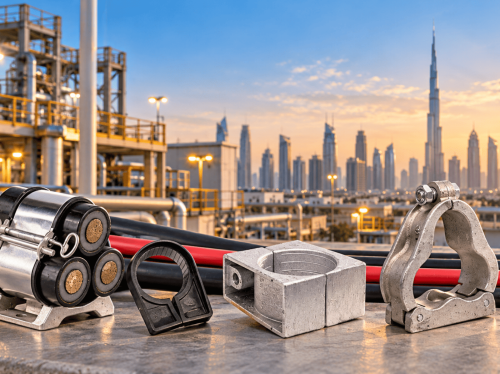
Misterlight’s current accessory portfolio includes cable glands, cable gland accessories, cable lugs and terminals, earthing materials, cable cleats, GI conduit and accessories and PVC conduits and accessories.
Think of it as a system:
Cable + Gland + Cleat + Lug + Conduit + Support
rather than six unrelated purchases.
10. Can the Supplier Support the Project Beyond the Product?
Price matters, but for electrical projects, product availability and technical support can matter just as much.
Before selecting a supplier, ask:
Can they supply the required cable type?
Can they provide consistent specifications across project quantities?
Can they supply compatible accessories?
Can they provide technical documentation?
Can they support different cable categories under the same project?
Can they meet the required delivery schedule?
This becomes particularly important on projects involving multiple specialist cable types.
A project could require power cables together with fire-performance cables, instrumentation cables, fibre optics and cable accessories.
Misterlight currently lists 36 cable products and 54 cable-accessory products across categories including fire performance, instrumentation, fibre optic, control and data, EV charging, flexible, heat-resistant and other specialist cables.
A Simple Electrical Cable Buying Checklist
Before sending a purchase order, make sure you can answer these questions:
|
Question |
What to Confirm |
|---|---|
|
1. Application |
What will the cable be used for? |
|
2. Cable size |
Is it correctly sized for load and installation conditions? |
|
3. Voltage |
Does the rated voltage match the system? |
|
4. Environment |
Indoor, outdoor, underground, industrial, high-temperature? |
|
5. Fire performance |
Is fire resistance or flame performance required? |
|
6. LSZH |
Are low-smoke/halogen requirements applicable? |
|
7. Construction |
Armoured, unarmoured, flexible, fixed, etc.? |
|
8. Standards |
Which standards, approvals or certifications apply? |
|
9. Accessories |
Are the glands, cleats, lugs and conduits compatible? |
|
10. Supplier |
Can the supplier provide products, documentation and support? |
3 Costly Cable-Buying Mistakes to Avoid
Choosing based only on price
The cheapest cable may not meet the project’s required specification, environmental conditions or certification requirements.
Choosing based only on conductor size
A 10 mm² cable is not automatically appropriate simply because the load appears to require 10 mm². Installation conditions, voltage drop, grouping and temperature also need to be considered.
Ordering the cable without the accessories
A project can experience avoidable delays when the correct cable arrives but compatible glands, cleats, lugs or other accessories have not been specified.
Why Local Knowledge Matters for UAE Electrical Projects
Electrical projects in the UAE may involve a combination of authority requirements, project specifications, international standards and demanding environmental conditions.
For Dubai projects, DEWA publishes regulations and updates through its official regulatory resources, so project teams should always verify the latest requirements applicable to their installation rather than relying on an old specification or generic online advice. DEWA
This is particularly important for large commercial, industrial and infrastructure projects where cable performance, documentation and compliance are closely scrutinised.
Why Choose Misterlight for Electrical Cables & Accessories in the UAE?
Misterlight has been supplying specialised electrical products in the UAE since 1991, with its major business concentrated in Abu Dhabi and Dubai. The company describes itself as an ISO 9001:2015-certified electrical supplier and offers specialised electrical cables and accessories for multiple industrial sectors. misterlight.com
Its product portfolio includes:
Fire Performance Cables
Instrumentation Cables
Fibre Optic Cables
Control & Data Cables
Flexible Cables
EV Charging Cables
Heat-Resistant Cables
GI Conduit & Accessories
Cable Glands
Cable Cleats
Cable Lugs & Terminals
Earthing Materials
and other electrical accessories.
This broad portfolio allows project teams to look at cables and their associated installation components together, rather than sourcing every component independently.
For projects across the UAE and GCC, that can make specification and procurement more straightforward.
Frequently Asked Questions
How do I choose the right electrical cable?
Start with the application, then determine the required voltage, current, cable size, installation method, environmental conditions, construction, fire performance and applicable standards.
What factors affect cable sizing?
Load current, installation method, ambient temperature, grouping, cable length and voltage drop can all affect cable selection. DEWA regulations specifically require adequate sizing for the normal circuit current under applicable laying conditions and maximum ambient temperature. DEWA
Which cable is suitable for outdoor applications in the UAE?
There is no single cable suitable for every outdoor installation. Selection should consider temperature, UV exposure, moisture, mechanical protection, installation method and project specifications.
What is the difference between fire-resistant and flame-retardant cables?
Fire-resistant cables are generally designed to maintain specified circuit performance under defined fire-test conditions, while flame-retardant performance relates to limiting flame propagation. The applicable test standard should always be checked.
Do electrical cables require cable glands and cleats?
Many installations require appropriate accessories such as glands, cleats and lugs, but the exact requirements depend on the cable construction, equipment and installation method.
Why is cable certification important?
Certification and test documentation help demonstrate that the cable has been evaluated against the relevant standards and performance requirements specified for the project.
Where can I buy electrical cables and accessories in the UAE?
Misterlight supplies a broad range of specialised electrical cables and cable accessories from its UAE operations, with products covering power-related, specialist and installation-accessory requirements.
Conclusion
Buying electrical cables is not simply a matter of choosing the right conductor size and comparing prices.
The right cable selection starts with the application. From there, consider the load, voltage, installation method, environmental conditions, fire-performance requirements, applicable standards, compatible accessories and the supplier’s ability to support the project.
As projects in the UAE become increasingly specialised, this complete approach can help engineers, contractors and procurement teams avoid costly specification and compatibility issues.
Whether the requirement involves power cables, fire-performance cables, instrumentation cables, fibre optics, flexible cables or cable accessories, selecting the right product starts with asking the right questions.
Planning an electrical project in the UAE or GCC? Talk to Misterlight about your cable and cable-accessory requirements.